
Every year, consumers leave billions of dollars sitting on gift cards they never spend. In many states, those unused balances do not simply become profit for the retailer. After a set period of inactivity, the law treats them as abandoned property that must be reported and turned over to the state, which holds the money for the card's owner.
When a company quietly keeps those balances, the people best positioned to know are its own employees and business partners. Under the false claims acts of many states, those insiders can report the misconduct, bring a case on the state's behalf, and receive a share of what the state recovers. New York alone has recovered more than $40 million in two gift card cases started by whistleblowers.
How gift card escheat works – and how companies avoid it
State unclaimed property (or "escheat") laws require a business holding money that belongs to someone else to turn it over to the state once the owner has gone silent for long enough. The rules for gift cards vary widely. New York, for example, requires issuers to turn over unused balances after five years of inactivity, and Delaware's law also expressly reaches gift cards. New Jersey has treated stored value cards as unclaimed property since 2010, presuming them abandoned after five years. Other states exempt gift cards entirely.
Which state gets the money depends on rules set by the U.S. Supreme Court. When the owner's address is unknown – the norm for gift cards – the money generally goes to the state where the issuing company is incorporated. That rule creates a temptation, and the schemes that follow from it tend to look alike:
- Moving the cards to an out-of-state affiliate on paper. A retailer forms or hires a gift card company in a state that exempts gift cards and claims that company "issues" the cards, while the retailer keeps running the program and keeping the money.
- Misleading regulators. When a state auditor or comptroller asks questions, the company describes its program in ways that don't match how it actually operates.
- Booking "breakage" as revenue. The company counts unredeemed balances as income while filing no unclaimed property reports, or reports that leave gift cards out.
- Incomplete voluntary disclosures or audit responses that omit gift card liabilities.
How whistleblowers can be paid for reporting it
Most false claims acts are best known for fraud in government contracting and Medicaid billing. But modern versions also reach "reverse false claims": knowingly making a false record or statement material to an obligation to pay money to the government, or knowingly concealing or improperly avoiding that obligation. A duty to turn over abandoned gift card balances is exactly that kind of obligation.
Many of these laws include a qui tam provision. It lets a private person – called a relator – file a lawsuit on the state's behalf, under seal, while the attorney general investigates. If the case succeeds, the relator receives a share of the recovery, commonly between 15 and 30 percent depending on the state and on whether the government takes over the case. Defendants can face up to three times the state's losses plus per-violation penalties, which is why these cases can be worth far more than the unpaid balances alone.
New York and New Jersey are among roughly two dozen jurisdictions whose false claims acts cover any money owed to the state, not only Medicaid fraud. The New Jersey False Claims Act (N.J. Stat. Ann. §§ 2A:32C-1 et seq.), like New York's, reaches reverse false claims and lets whistleblowers sue on the state's behalf.
Most state false claims acts also protect employees from being fired, demoted or harassed for investigating or reporting a violation.
Whistleblower cases have already produced major recoveries
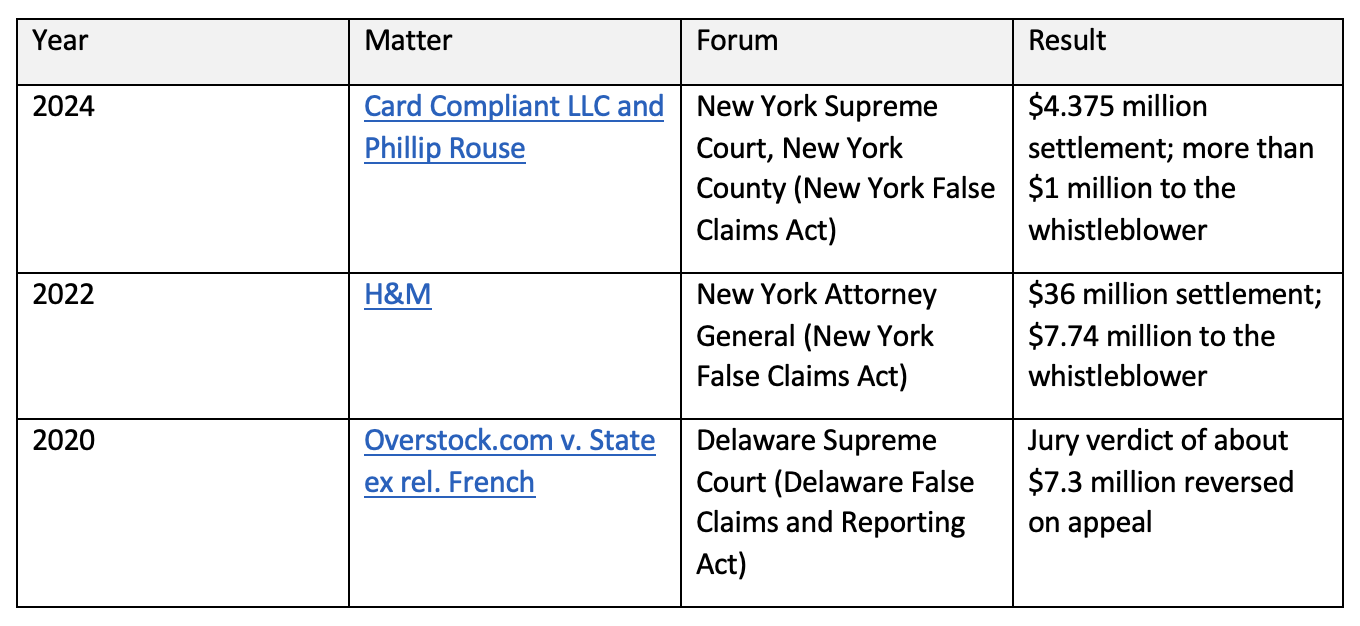
H&M. H&M learned in 2008 that it had to turn unredeemed balances over to the state. It then signed a contract with an out-of-state company that gave the false impression that company ran H&M's gift card business. When state officials asked about the program, H&M made false statements again. The case began with a whistleblower suit filed under the New York False Claims Act.
Card Compliant. In a related settlement, the Kansas-based gift card company behind that arrangement paid $4.375 million. New York alleged that the company made false statements to the State Comptroller and advised H&M to do the same.
Overstock. In Delaware, a relator's case against Overstock.com ended in a jury verdict of $7,266,413 in treble damages plus $22,000 in penalties. The Delaware Supreme Court reversed in 2020. It held that under the version of the statute in force for those years, simply failing to file escheat reports was not a "false record or statement." Delaware had already amended its law in 2013 to cover knowingly concealing or improperly avoiding an obligation to pay the state, so that gap does not exist for later conduct.
Who should come forward – and how
Valuable information comes from people who see how a gift card program really runs:
- Finance and accounting staff who book gift card liabilities and "breakage" revenue
- Unclaimed property, tax and compliance personnel who prepare (or skip) state reports
- Employees of third-party gift card program managers and processors
- Managers who negotiated or administer contracts with an affiliated or outside gift card issuer
- Auditors, consultants and others who reviewed the program's structure or responses to state audits
Helpful evidence includes contracts and intercompany agreements, accounting entries, internal emails about escheat obligations, and correspondence with state auditors or comptrollers.
Timing matters. These laws generally reward the first person to file, and claims based on information already public may be barred. Cases are filed under seal, so the company is not told while the state investigates.
Talk to us. Pollock Cohen LLP represents whistleblowers in false claims act cases, including gift card escheat investigations. If you have information about a company keeping unclaimed gift card balances, contact us for a confidential consultation.
This post is for general information and is not legal advice. Reading it does not create an attorney-client relationship. Attorney advertising; prior results do not guarantee a similar outcome.